August in Akumal is really two months. Early August is crowded, expensive and heavy with seaweed; late August brings hatchlings, falling prices and thinning crowds. This guide covers the weather, the split, the hurricane risk, and how to time it.
What You Should Know
- August behaves like two different months. The first three weeks are the summer's busiest and priciest, while the last ten days usually see crowds thin, rates drop, and sargassum often begin to ease.
- Hatchling season gets going. Nests laid in June and July complete their 45 to 60 day incubation, so releases typically build from late August, overlapping with females still coming ashore to nest.
- This is where August differs most from July: Atlantic hurricane season enters its peak stretch, running roughly from August into early October. Storms rarely hit directly, but flexible bookings matter more now.
- Sea temperature peaks around 29°C (84°F), the warmest of the year, which makes long snorkels comfortable but does nothing for the seaweed. The bay still holds what lands in it.
Akumal in August: What to Expect
⭐ Best August window: usually the last ten days. This is the inverse of July, where the early days won. From roughly August 21 the school-holiday crowds thin, rates step down, hatchling activity is building, and the sargassum often starts to ease. The tradeoff is that you are moving deeper into hurricane season.
August is the month where Akumal's calendar pivots, and treating it as one uniform month is the most common planning mistake. Early August is a continuation of July at slightly higher intensity: hot, humid, crowded, and weedy. Late August is a different proposition, with a genuine drop in crowds and prices, hatchlings starting to appear, and the beach often improving. The gap between an August 5 trip and an August 26 trip is wider than the gap between most adjacent months.
| Factor | August Rating |
|---|---|
| Weather | 5/10 · hottest and wettest of the summer so far |
| Crowds | 6/10 · busy for three weeks, then a real drop |
| Prices | 8/10 · among the year's cheapest, lowest late in the month |
| Beaches | 3/10 · sargassum high, often improving in the final stretch |
| Turtle Snorkeling | 8/10 · reliable; warmest water of the year |
| Cenotes | 10/10 · the standout, and the best relief from the heat |
| Sargassum | 3/10 · heavy, with a late-month easing more often than not |
| Hurricane Risk | 4/10 · peak stretch opens; direct hits remain uncommon |
| Families | 7/10 · shallow bay and hatchlings, but heat and early crowds |
💰 Average August hotel prices (Akumal, mid-range):
Boutique hotels and condos: ~$160/night · Mid-range and villa rentals: ~$195/night · All-inclusive resorts: ~$330/night
Rough mid-range estimates. Early-August family dates run higher and the final ten days run lower, and all vary considerably by property, by which bay it sits on, and by lead time.
Who August suits. We'd expect this to work best for travelers with date flexibility, because almost all of August's value sits in its last third. A late-August booking gets you hatchling season, softer prices, and thinner crowds for the same activities that cost more three weeks earlier. We'd look elsewhere if your dates are locked to the first half of the month and the beach matters to you, because early August offers July's drawbacks with slightly worse weather and no compensating discount.
Hidden Cenote Swim: Snorkeling, Sea Turtles & Beachside Lunch
We'd book this if you have one day to get right in August. The turtle bay is at its warmest and the cenote is the most reliable answer to both the heat and an afternoon storm, since it is underground and unaffected by what the weather or the sea is doing. It also carries the largest review base of the combination tours, which matters more in a month when itineraries get rearranged around rain.
Book NowBest Things to Book in Akumal in August
Free cancellation earns its keep in August more than in any other summer month, because storms and hurricane-season disruption are both live possibilities. These are the options we'd shortlist for the month.
| Tour | Why It Works in August | Price | Rating | Full Guide & Book |
|---|---|---|---|---|
| Turtle snorkel & cenote | Warmest water of the year plus a storm-proof cenote | From $119 | 4.8 (1,376) | Guide · Check availability |
| Private Akumal turtle snorkel | Can be moved to the clear early window on short notice | From $40 | 4.7 (124) | Guide · Check availability |
| Full-day ruins, cenote & turtles | Ruins at opening, before August heat and storms build | From $130 | 4.8 (1,326) | Guide · Check availability |
| Private turtle & cenote tour | Sets its own order, so it can dodge an afternoon downpour | From $274 | 5.0 (283) | Guide · Check availability |
| Swim with sea turtles | Short and cheap, easy to slot into a clear morning | From $45 | 4.6 (452) | Guide · Check availability |
ℹ️ Prices, ratings, and review counts were reviewed by our team in August 2026 and are shown as listed. Life jackets are mandatory in the guided turtle zone and a minimum-distance rule applies to the turtles, commonly cited as somewhere between 3 and 4.5 metres (10 to 15 feet). Confirm current pricing and the local conservation fee before booking.
Akumal Weather in August
| Metric | August |
|---|---|
| Avg High | 32°C (89°F) |
| Avg Low | 26°C (79°F) |
| Water Temp | 29°C (84°F), the year's warmest |
| Rain Days | ~13, afternoon showers and thunderstorms |
| Humidity | High (around 81%) |
| Wind | Low to moderate |
| Hurricane Risk | Moderate; peak stretch runs August into early October |
Temperature and Humidity
August highs average around 32°C (89°F), with overnight lows near 26°C (79°F). That low is the number worth noticing: it is a couple of degrees above July, and it means the nights stop providing much relief. Combined with humidity around 81%, August is the most consistently uncomfortable month of the Akumal year for anything strenuous in open sun.
Rain Pattern
Rainfall rises to roughly 146mm across about thirteen days, up from July on both counts. The pattern is the same convective one, with storms building through the afternoon and clearing, but August adds occasional heavier and longer events as the tropical season matures. In reality this rarely writes off a day, though it does argue for booking activities that can be reordered rather than a fixed sequence.
Hurricane Season
This is the meaningful difference from July. Atlantic hurricane season runs June to November, and August marks the start of its peak stretch, which continues into early October. A direct hit on any given week remains unlikely, but the practical effects are wider than landfall: systems tracking through the Yucatán Channel can bring several days of heavy rain, wind, and large swell without ever coming ashore. The main thing we'd watch for is not a named storm on your dates but whether your bookings can absorb one, so free cancellation and travel insurance carry real value this month.
Sea Conditions
Sea temperature peaks around 29°C (84°F), the warmest of the year, which makes long snorkels genuinely comfortable and is one of August's few unambiguous advantages. Wind stays low to moderate. Swell from distant tropical systems is the variable to watch, since it can reduce inshore visibility for a day or two even in fine local weather.
Crowds and Prices in Akumal in August
August is the clearest example on the Akumal calendar of a month where the dates matter more than the month. The split is sharp enough to be worth planning around.
- August 1 to 10: the summer's peak. European and North American school holidays fully overlap, morning snorkel slots go early, and rates sit near their August high.
- August 11 to 20: still busy, with the first signs of easing as some European holidays wind down. Availability improves slightly, prices hold.
- August 21 to 31: the turn. North American schools go back, crowds thin noticeably, rates step down, and the bay's entry points become manageable again. Hatchling activity is building at the same time.
On price, August sits alongside July as one of the two cheapest months of the year, running around $195 a night for mid-range lodging, with boutique hotels and condos nearer $160 and all-inclusive resorts around $330. Those are month averages, and the final ten days sit meaningfully below them.
Based on what we've seen across the corridor, the late-August window is the single best value stretch of the Akumal summer: you get the same warm water and the same tours for less money, with fewer people in the bay and a better chance of a cleaner beach. The only thing you are paying more of is hurricane-season risk. For how the wider corridor prices out this month, see our Riviera Maya in August guide.
Turtle Hatchling Season in Akumal in August
August is when the turtle story shifts from nesting to hatching. Nests laid in June and July complete their 45 to 60 day incubation through the month, so hatchling emergences typically build from late August and continue into the autumn, with peak hatching generally running from the last days of August into early October. Females are still coming ashore to nest at the same time, which is why you can see nesting adults and brand new hatchlings on the same stretch of beach in the same week.
Three species nest along this coast: green turtles (Chelonia mydas), loggerheads (Caretta caretta), and the rarer hawksbill (Eretmochelys imbricata). The Centro Ecológico Akumal patrols and protects nests through the season and organises public hatchling releases when protected nests are ready. These are not bookable as tours and cannot be scheduled in advance, since they depend on when nests actually emerge, so the practical approach is to ask locally as soon as you arrive and stay flexible in the evenings.
In our experience the mistake worth avoiding is treating a hatchling release as a guaranteed itinerary item. It is a genuine highlight and late August gives you a real chance at one, but the timing is set by the turtles rather than by anyone's calendar. We'd treat it as an excellent possibility rather than a reason to book specific dates.
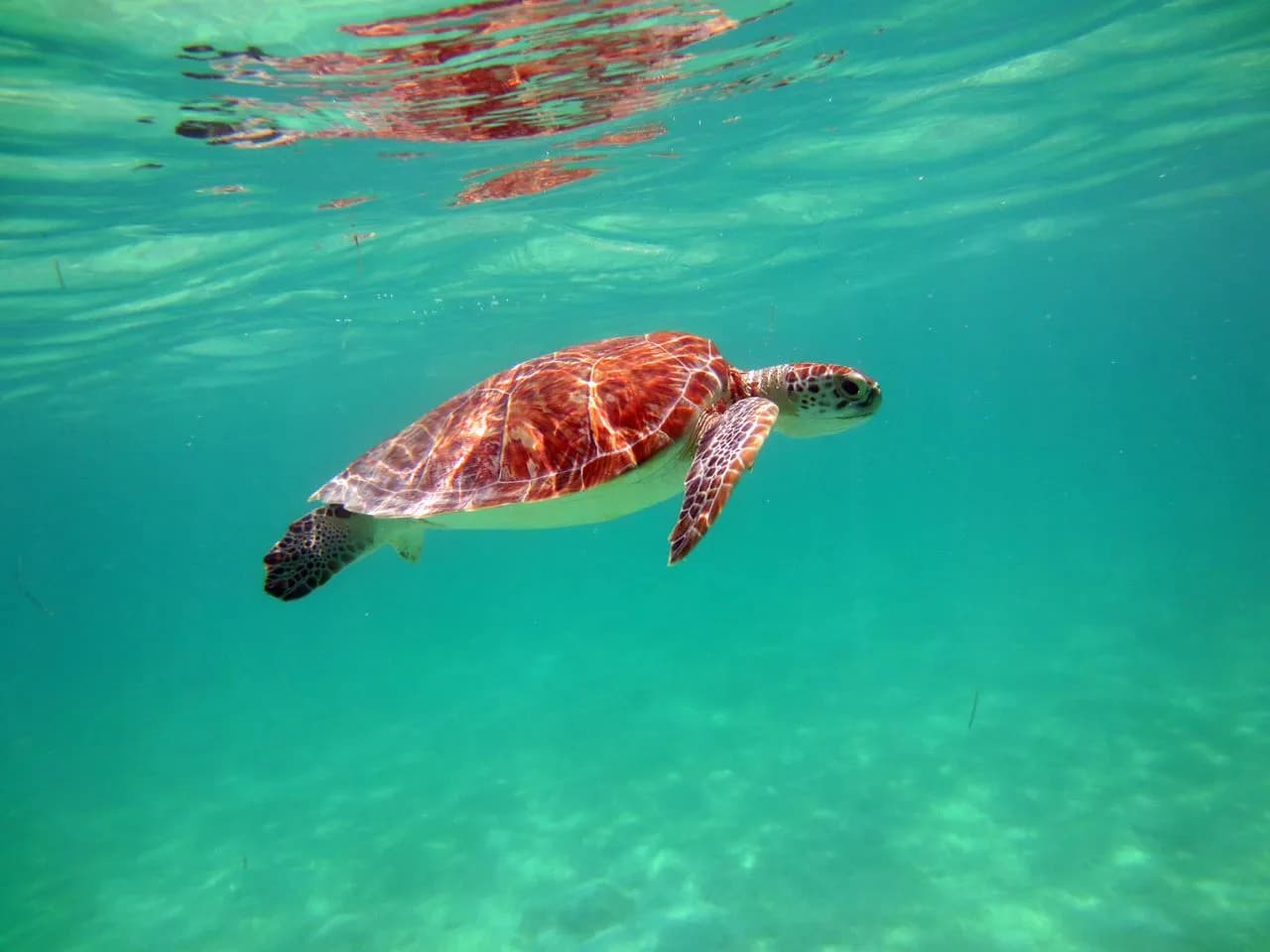
The daytime turtle snorkel in the bay runs separately and is unaffected by any of this: those green turtles are resident foragers on the seagrass beds, not the nesting adults. Our Akumal snorkeling tour guide covers the operators and entry points. As in July, guided snorkeling is not run on Mondays, a conservation rest day, though independent snorkelers can enter before 10am that morning.
Sargassum in Akumal in August
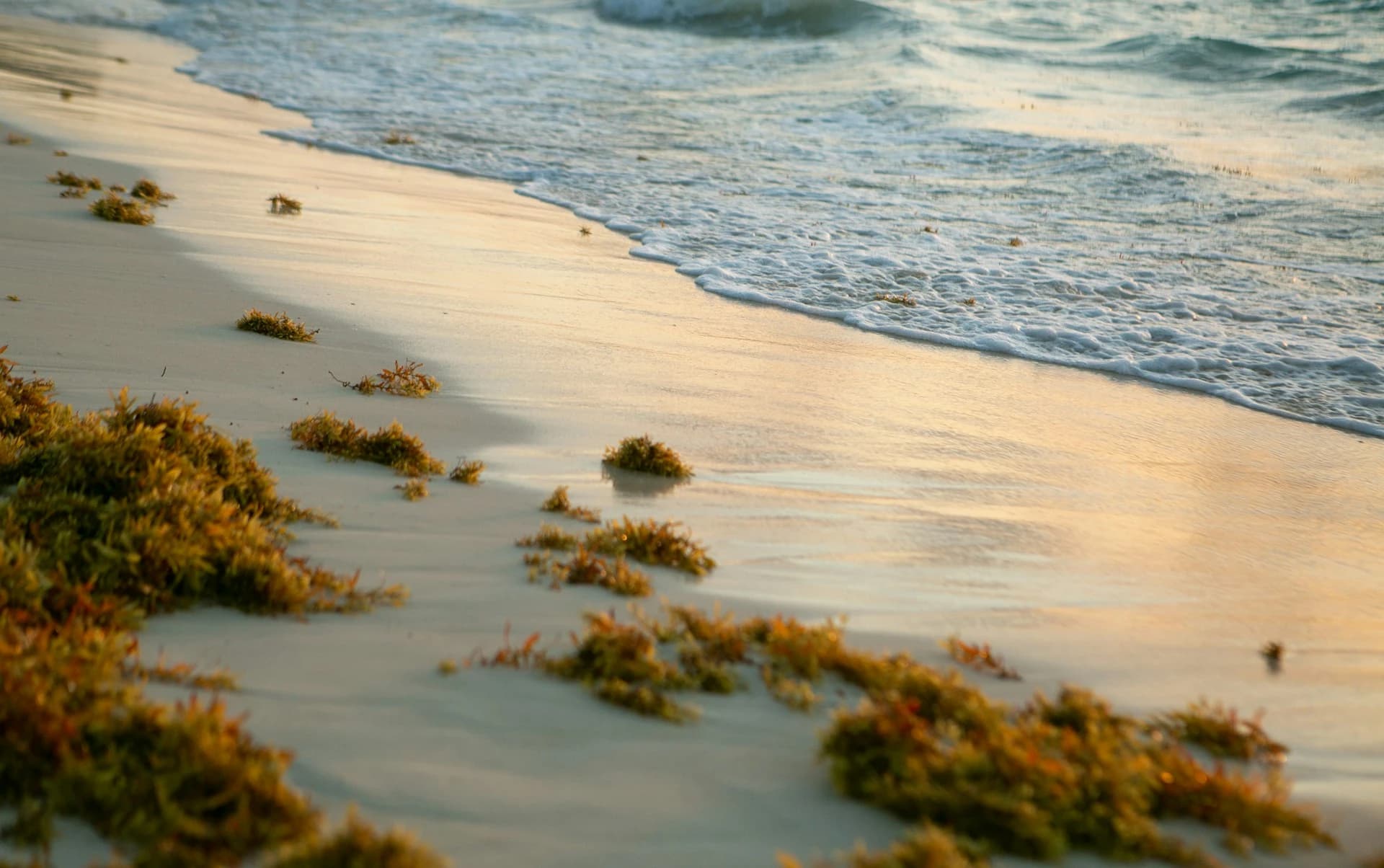
August is typically heavy, close to July, with one important difference: it often begins to ease in the final week or two. That easing is not guaranteed and it varies year to year, but the late-August improvement is common enough that it reinforces the case for timing a trip toward the end of the month.
The mechanics are unchanged from July. Akumal Bay is semi-enclosed, bounded by headlands and partly fronted by reef, and while the reef intercepts a share of the incoming rafts, the bay exchanges less water than an open beach and holds what gets through. As always here, two things move in opposite directions through the morning: the sand tends to look worst first thing, because the weed lands overnight before crews have worked it, while conditions in the water are generally best early and deteriorate as the bay fills with people from around 10am.
The alternatives are the same and they work just as well: Yal-Ku Lagoon two kilometres north sees very little of it, the rocky ironshore at North Akumal accumulates less than the sandy crescents, and Half Moon Bay is the worst-affected stretch. The cenotes inland are freshwater and outside the weed's reach entirely. Our full Akumal sargassum guide covers the month-by-month pattern and the live trackers worth checking before you travel.
Best Things to Do in Akumal in August
| Activity | August Rating | Best Time of Day | Notes |
|---|---|---|---|
| Cenote swim or dive | 10/10 | Midday or during rain | Underground, so storms and heat are irrelevant |
| Whale shark tour | 9/10 | Early morning | Peak season continues; season closes mid-September |
| Akumal turtle snorkel | 8/10 | 8 to 9am | Warmest water of the year; go before the 10am rush |
| Yal-Ku Lagoon | 9/10 | Morning | Sheltered and clear when the bay is not |
| Hatchling release | 8/10 | Dusk | Builds late August; unscheduled, ask locally |
| Reef diving | 7/10 | Morning | Warm and calm; distant swell can cut visibility |
| Sian Ka'an lagoon | 6/10 | Morning | Storm cancellations more likely than in July |
| Tulum ruins | 4/10 | At opening | Fully exposed; August heat and humidity are worse than July |
| Beach lounging | 3/10 | — | Sargassum heavy, though often improving late month |
Book things that can move
This is where operators really differ in August. A fixed-departure group tour that runs rain or shine is a different proposition from a private tour that can reorder its stops or shift a day, and in a month with thirteen rain days and live hurricane-season risk that flexibility is worth paying for. We'd make sure to check the cancellation window rather than just the price when comparing two similar-looking listings.
Cenotes do even more work than in July
In July the cenotes were the answer to the heat. In August they are the answer to the heat and the rain, because being underground makes an afternoon storm irrelevant. Dos Ojos to the south, Taj Mahal near Xpu-Ha, and Aktun Ha inland on the Tulum to Cobá road all work as wet-weather plans that lose nothing for being wet-weather plans. See our Tulum cenote tour guide for the options.
Other Things Worth Doing in August
- Evening beach walks: late August overlaps nesting adults and emerging hatchlings, which is the most interesting the beach gets all year. Red light only, and keep well back from marked nests.
- Aktun Chen: a cave and underground river park minutes away, effectively indoors, and the most reliable answer to a washed-out afternoon.
- Xel-Há and Xcaret: both built around sheltered inlets and freshwater, so they hold up far better than an open beach day in a weedy month.
- Shore-entry reef diving at the ironshore: the northern sites reach clear water quickly and skip the weediest inshore stretches.
- Tulum dining and mezcal evenings: a good use of the hours after the heat breaks, and unaffected by whatever the beach is doing.
- Airport logistics: Akumal sits about 90km south of Cancún airport, roughly a 75 to 80 minute drive. Our Cancún airport to Akumal transfer guide covers the options.
From Our Experience
What we consistently see is that August rewards people who can move their dates and punishes people who cannot. Shifting a trip from the first week to the last week of the same month changes the crowds, the price, and often the beach itself, for identical weather and identical tours. If your dates are fixed to early August, plan it as a July trip and set your beach expectations accordingly.
Tips for Visiting Akumal in August
- Aim for the last ten days if you have any flexibility: crowds thin, rates drop, hatchling activity builds, and the sargassum often starts easing. It is the best-value window of the Akumal summer.
- Book refundable rates and consider travel insurance: August opens the peak stretch of hurricane season, and the realistic risk is several disrupted days from a passing system rather than a direct hit.
- Be in the water by 8 or 9am: expect the sand to look its worst then, since the weed lands overnight, but conditions in the water are generally best early and the bay fills from around 10am.
- Favour tours that can be reordered: with about thirteen rain days, a private or flexible itinerary is worth more in August than the price gap suggests.
- Ask about hatchling releases the day you arrive: they cannot be scheduled ahead, so local knowledge on arrival is the only way to catch one.
- Carry cash for the conservation fee: reported amounts commonly run between $15 and $35 per person depending on the operator and what is included, so confirm the figure when you book.
- Pack for humidity and rain, not just heat: quick-dry clothing, a light rain layer, and reef-safe mineral sunscreen, which is required around the turtle zones.
- Comparing months? Our Akumal in July guide covers the month before, when the early days rather than the late ones are the window to aim for, and our Akumal sargassum guide has the full seaweed calendar.
- Looking at September instead? Our Akumal in September guide covers the year's cheapest and quietest month, when the beach finally improves but hurricane season peaks.
How We Selected These Tours
The Cancun Trip Insider team assessed these August options against the two things that actually go wrong this month: storms that rearrange a day, and a bay that gets crowded and weedy by mid-morning. Tours that can be reordered or rescheduled scored higher than fixed sequences. Every listing here comes from a highly rated operator, with ratings and review counts shown as published. We passed over options with restrictive cancellation terms, unclear turtle-zone permissions, or thin review histories, all of which matter more in hurricane season. The set spans short beach snorkels, cenote and turtle combinations, full-day ruins trips, and private tours with flexible timing, so an early start and a weather-proof backup are possible at most budgets.
Frequently Asked Questions
Is Akumal good in August?+
It depends heavily on your dates. The first three weeks are hot, humid, crowded and weedy, essentially July with worse weather. The last ten days are among the best value of the Akumal year, with crowds thinning, prices dropping, hatchling season building, and the sargassum often easing. Hurricane risk is higher throughout.
What is the weather like in Akumal in August?+
Hot, humid and stormier than July. Highs average around 32°C (89°F) with lows near 26°C (79°F), so nights offer little relief, and humidity sits around 81%. Expect roughly 146mm of rain across about thirteen days, mostly afternoon thunderstorms. Sea temperature peaks around 29°C (84°F), the warmest of the year.
Can you see turtle hatchlings in Akumal in August?+
Often, particularly late in the month. Nests laid in June and July finish their 45 to 60 day incubation through August, so emergences typically build from the final week and continue into the autumn. Releases are organised by the local ecological centre rather than sold as tours, and cannot be scheduled ahead, so ask locally on arrival.
Is sargassum bad in Akumal in August?+
Yes, August is typically heavy, close to July. The difference is that it often begins easing in the last week or two, though that varies year to year. The bay's semi-enclosed shape holds what lands, so plan around it: go in early, use Yal-Ku Lagoon and the North Akumal ironshore, and keep cenote days in the itinerary.
Is August expensive in Akumal?+
No, it is one of the two cheapest months alongside July, at roughly $195 a night for mid-range lodging, around $160 for boutique hotels and condos, and about $330 for all-inclusive resorts. Those are month averages and the final ten days run meaningfully below them, which is where August's value is concentrated.
What is the best week to visit Akumal in August?+
Usually the last ten days, from around August 21. North American schools go back, so crowds thin and rates step down, hatchling activity is building, and the sargassum often starts to improve. This is the inverse of July, where the first ten days are the window. The tradeoff is deeper hurricane-season exposure.
Is hurricane season a problem in Akumal in August?+
It is worth planning for rather than avoiding. Atlantic hurricane season runs June to November and August opens its peak stretch, continuing into early October. Direct hits in any given week remain uncommon, but systems passing through the Yucatán Channel can bring several days of rain, wind and swell. Book refundable rates and consider travel insurance.
Is July or August better in Akumal?+
Late August is the best window of the two, with lower prices, thinner crowds, hatchlings, and often an improving beach. Early August is the worst of both, offering July's crowds and seaweed with hotter, wetter weather and no discount. If your dates are fixed to early in the month, July generally edges it.
Affiliate note: Some links on this page are affiliate links. If you book through them, we may earn a small commission at no additional cost to you.